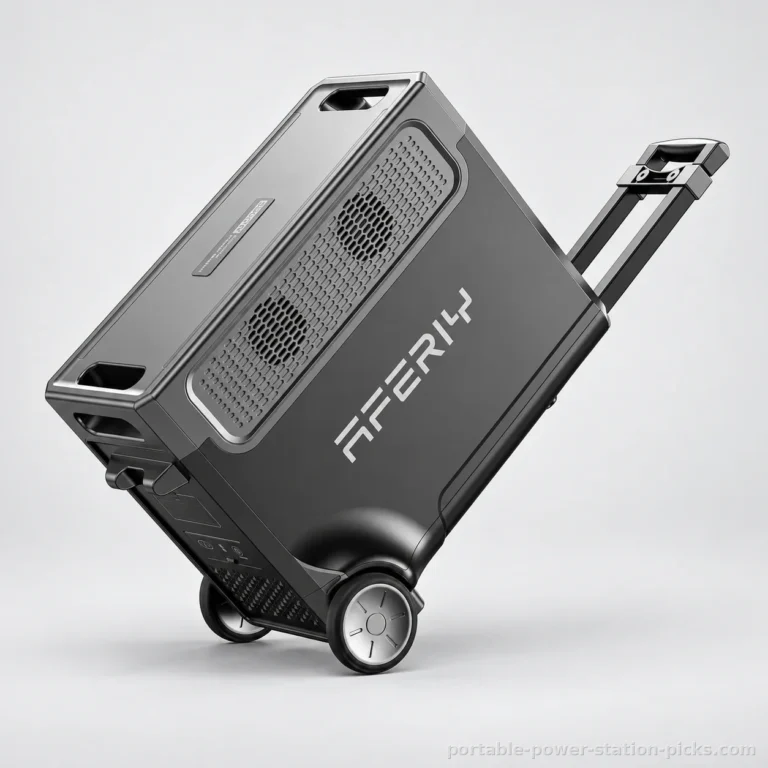
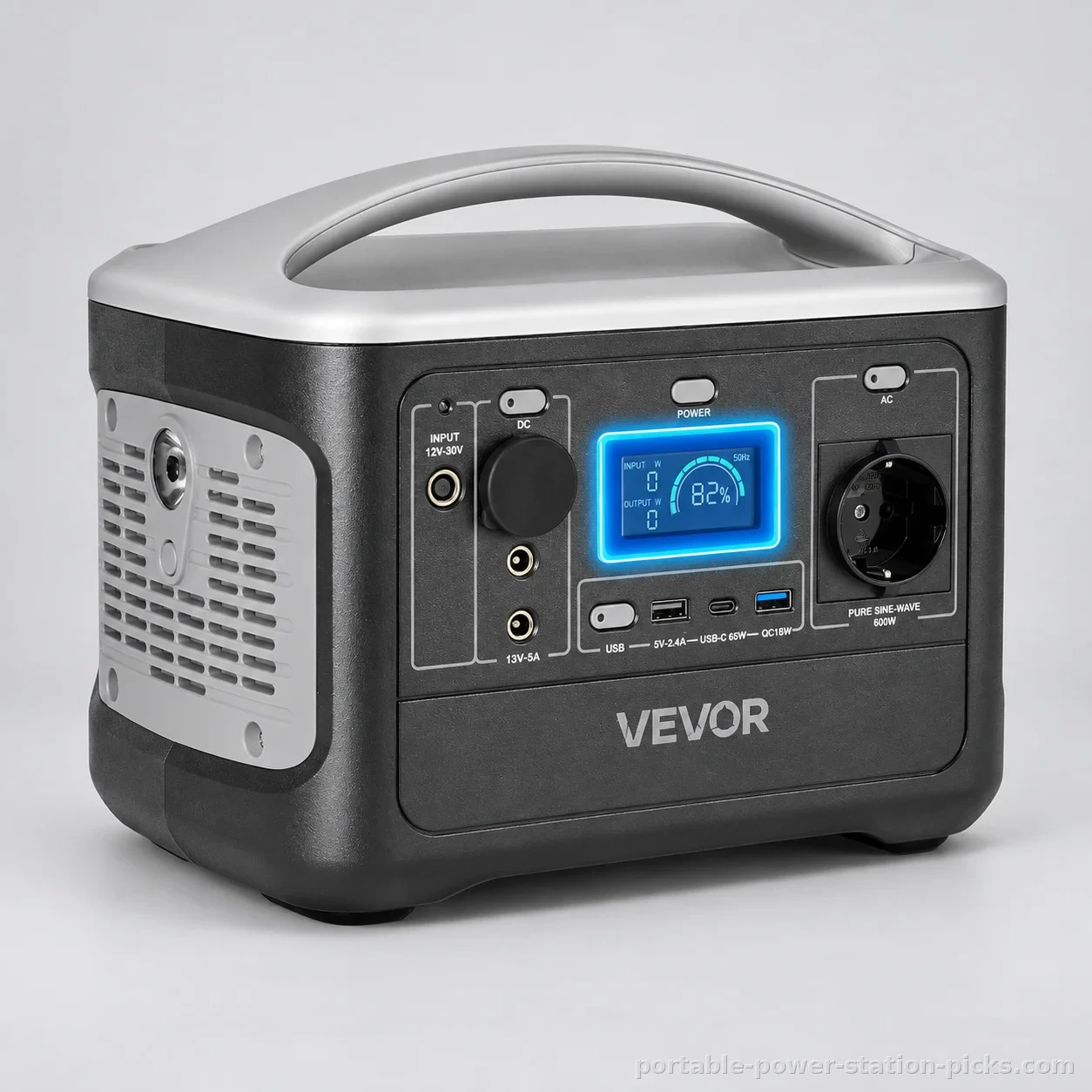
Real and AI-generated images for illustration to help you picture the product • Find more photos on the retailer's site.
VEVOR M6 600 W 493 Wh (portable power station for motorhome trips): our review
Brand: VEVOROur methodology
No verified local offers at present.
 AFERIY P310
8.8/10
See our pick →
A short carry gives the M6 a clear purpose
The M6 suits a short carry from your vehicle to a modest collection of devices. We like its combination of a carrying handle, solar compatibility, and capacity aimed at everyday electronics. Give it a focused job, and its purpose becomes much clearer.
Verdict
7.9/10Our M6 review favors prepared weekends and selected essentials
A lamp glowing beside a motorhome captures the M6's appeal: useful electricity within a short carry. We consider it well placed overall for that focused role. Small jobs give this battery a clear purpose.
Our verdict: We recommend it for campers and motorhome travelers supporting everyday electronics. The AFERIY P310 backup alternative is better suited to home backup and better rated overall.
Worth noting Avoid it if you routinely leave with a depleted battery and little warning. The long wait for a full mains charge is what holds us back; preparation needs to happen before departure becomes urgent.
Review by Romain Brunel, founder of Portable Power Station Picks
Who it's for
Who should pack this portable power station for camping?
- Motorhome travelers charging everyday electronics
- Campers keeping equipment near their parked vehicle
- Households supporting selected essentials during an outage
This station suits motorhome travelers and campers who want phones, a lamp, and a laptop supplied near their parked vehicle. Think of an evening under the awning, sorting tomorrow's route while someone reads nearby. Its 5.80 kg weight and carrying handle make that short move practical.
Less suitable if
Skip this model if your main goal is running heating appliances or supplying a broad collection of household equipment. Its 600 W output belongs with modest loads, and a motor-driven appliance still needs its startup requirements checked separately.
Dimensions
Where would this portable battery ride in your vehicle?
| Length | Not specified |
| Width | Not specified |
| Height | Not specified |
| Weight | 5,80 kg |
Specifications
A 493 Wh reserve puts everyday electronics in focus
| Rated power | 600 W |
| Battery capacity | 493 Wh |
| Weight | 5,80 kg |
| Mains charging time | 7,5 h |
| Maximum solar input power | 100 W |
| Solar | Solar charging compatible |
| Use | Motorhome |
| Battery technology | LiFePO4 |
| Non-USB DC outputs | 12 V cigarette lighter socket |
| Built-in transport features | Carrying handle |
| Mains charging | Approximately 7,5 h |
| Car cigarette lighter socket output | 12 V/8 A |
| Number of 230 V sockets | Not specified (unverified) |
“unverified”: among the 5 essential specifications (Rated power, Battery capacity, Weight, Number of 230 V sockets, Mains charging time), a value found online that no verified source (archived retailer page or manufacturer documentation) confirms. Other rows are not subject to this check.
Pros
The M6 brings useful power within a short carry
- A 493 Wh reserve suited to phones, a lamp, and a laptop
- Carrying handle for short moves between vehicle and campsite
- LiFePO4 battery chemistry
- Solar compatibility for supplemental charging
Cons
Leaving suddenly exposes the M6's biggest compromise
- 7.5 h mains charging makes sudden departures awkward
- Modest solar input keeps solar charging in a supporting role
- Heating appliances fall outside its intended workload
Our scores explained
Every model on the site is scored on the same criteria, using the same scale: its position among models with verified data for that specification. Last place earns 6.5, first place 9.6, and the rest are scored in proportion to their rank. Here is how this model's scores are calculated.
Two model counts: the rank and average include product pages on this site scored for the criterion; the calculation compares the model with all catalogue models whose specification is verified, with or without a product page. A score assigned at publication may remain without a verified specification, so the first count can sometimes be higher.
Rated power: 7.3/10
VEVOR M6 600 W 493 Wh scores 7.3/10 on this criterion. Across the 25 product pages on the site with a score for this criterion, the average is 8.2: below average, Rank 20 out of 25.
View calculation
| Shared baseline: last place in the ranking | 6.5 |
|---|---|
| Rated power: 600 w ; 6 perform worse, 22 perform better, 3 are tied (including this model), among the 31 catalogue models with this specification verified | +0.8 |
| Rated power score | 7.3/10 |
Calculation: (6 + 3 ÷ 2) ÷ 31 = 24.19% of the ranking; 6.5 + 24.19% × 3.1 = 7.3/10, rounded to one decimal place.
Battery capacity: 7.1/10
VEVOR M6 600 W 493 Wh scores 7.1/10 on this criterion. Across the 25 product pages on the site with a score for this criterion, the average is 8.1: below average, Rank 22 out of 25.
View calculation
| Shared baseline: last place in the ranking | 6.5 |
|---|---|
| Battery capacity: 493 wh ; 5 perform worse, 24 perform better, 1 are tied (including this model), among the 30 catalogue models with this specification verified | +0.6 |
| Battery capacity score | 7.1/10 |
Calculation: (5 + 1 ÷ 2) ÷ 30 = 18.33% of the ranking; 6.5 + 18.33% × 3.1 = 7.1/10, rounded to one decimal place.
Weight: 8.8/10
VEVOR M6 600 W 493 Wh scores 8.8/10 on this criterion. Across the 20 product pages on the site with a score for this criterion, the average is 7.9: above average, Rank 4 out of 20.
View calculation
| Shared baseline: last place in the ranking | 6.5 |
|---|---|
| Weight: 5.8 kg ; 17 perform worse, 6 perform better, 1 are tied (including this model), among the 24 catalogue models with this specification verified | +2.3 |
| Weight score | 8.8/10 |
Calculation: (17 + 1 ÷ 2) ÷ 24 = 72.92% of the ranking; 6.5 + 72.92% × 3.1 = 8.8/10, rounded to one decimal place.
Equipment: 8.2/10
VEVOR M6 600 W 493 Wh scores 8.2/10 on this criterion. Across the 26 product pages on the site with a score for this criterion, the average is 8: above average, Rank 8 out of 26.
View calculation
| Shared baseline: last place in the ranking | 6.5 |
|---|---|
| 4 features found out of 13 tracked: 13 perform worse, 9 perform better, 10 are tied (including this model), among the 32 catalogue models with this specification verified | +1.7 |
| Equipment score | 8.2/10 |
Calculation: (13 + 10 ÷ 2) ÷ 32 = 56.25% of the ranking; 6.5 + 56.25% × 3.1 = 8.2/10, rounded to one decimal place.
Recorded features: Solar (Solar charging compatible), Battery technology (LiFePO4), Non-USB DC outputs (12 V cigarette lighter socket), Built-in transport features (Carrying handle).
The retailer does not specify: Expansion battery, App connectivity. These features are not counted.
The value for “Number of 230 V sockets” listed in the specifications (Not specified) is not confirmed by any verified source: this criterion is not scored and is excluded from the overall score.
Overall score: 7.9/10, the average of the 4 scores above.
Detailed analysis
The campsite's water pump is a walk away, dinner needs organizing, and your phone is heading toward an inconvenient shutdown. The VEVOR M6 600 W 493 Wh offers a small reserve for everyday electronics and selected modest loads. Its appeal is easy to understand: carry power over to where you need it. The buying decision comes down to how much equipment you expect that reserve to support, and how you prepare before leaving.
The M6 600 W 493 Wh portable power station keeps the job small
A summer storm cuts the lights while dinner is still on the table. You want a lamp, charged phones, and perhaps a laptop to finish something before bedtime. With 493 Wh of stored energy, the M6 belongs in that modest support role. What would you keep running first? We would start with the devices that keep the evening organized, then decide whether anything else needs a turn.
The rated 600 W output gives a small fridge or a light-duty tool a place in the conversation, provided the appliance's requirements fit. A heating appliance belongs outside that plan. For a fridge, account for its starting surge separately. Stored energy and available power answer different questions: the battery determines the reserve, while the output determines which loads it can support at a given moment. Keep the assignment focused.
Carry the M6 600 W 493 Wh portable power station from van to table
A motorhome is parked near a trailhead, with lunch outside and charging equipment still inside. At 5.80 kg, this station is a realistic handle carry over a short distance. Moving it from the vehicle to a sheltered table makes more sense than adding it to your hiking pack. The sandwiches already have enough competition for backpack space.
We like that straightforward role: portable electricity close to the vehicle, with a carrying handle to make the move practical. Its battery uses LiFePO4, a useful detail when choosing a portable reserve, although chemistry alone cannot promise a particular service life. A 12 V cigarette lighter socket provides a connection for compatible DC equipment; match the device's electrical requirements before connecting it. For a motorhome trip, we consider the M6 well placed overall when the plan centers on personal electronics and modest loads.
The M6 needs 7.5 h at an outlet before departure
A spontaneous invitation to spend the weekend beside a lake sounds better when the camping equipment is already ready. The M6's 7.5 h mains charging time makes a depleted battery awkward for an unplanned departure. Keep charging on the packing checklist instead of leaving it until the cooler goes into the vehicle. This is a station that rewards a little preparation.
Solar compatibility adds flexibility once you arrive. The maximum 100 W solar input is modest, suited to a supplemental panel rather than an ambitious array. Will you be parked somewhere sunny while you eat breakfast or walk nearby? That setting gives solar a useful supporting role. Actual input depends on the panel, sunlight, and orientation. Leave the station sheltered and charge it in a ventilated area, following the manual's guidance about rain and high heat.
Choose a different portable power station when the outage plan grows
The M6 makes the most sense when your list stops at a few selected needs. A broader household backup plan calls for a different choice. The AFERIY P310 is better suited to home backup and better rated overall. Consider the AFERIY P310 when supplying household essentials becomes the main reason for bringing a battery home.
The GENERGY GZE-3036-PRO-S for demanding appliances is better suited to demanding appliances and better rated overall. Consider the GENERGY GZE-3036-PRO-S when appliance requirements drive the decision, rather than the convenience of moving a reserve between your vehicle and a nearby table.
The Kodak S2400M for solar charging is better suited to substantial solar charging and better rated overall. If collecting solar energy is central to your travel plans, put the Kodak S2400M on your shortlist. Our preference for the M6 rests on a simpler assignment: electricity close to the devices that make an evening away from an outlet easier.
This portable power station features in

Analysis by Romain Brunel
Founder of Portable Power Station Picks
We analyse portable power station specifications using manuals, specification sheets and buyer reviews. We explain capacity, power output and charging criteria while distinguishing stated figures, estimates and documented limitations.
Updated on October 27, 2026
Frequently asked questions
Your questions about the M6 portable power station
Can the M6 600 W 493 Wh run a small fridge?
Its rated output puts a small fridge within consideration, provided the fridge's running requirements fit. Check the starting surge separately, too. The stored reserve is limited, so choose around the appliance's needs without assuming a particular runtime.
Does the M6 600 W 493 Wh support solar charging?
Yes. Its 100 W maximum solar input suits a supplemental panel. Actual charging input depends on sunlight, panel orientation, and the panel itself. Solar compatibility does not confirm that a panel or charging cables are included; confirm the package contents before ordering.
What should I confirm about the warranty before ordering?
We cannot give you a verified warranty term. Ask the retailer for the written coverage and the process for getting help if something goes wrong, especially if you expect to travel with the station.
How should I position this power station at camp?
Keep it sheltered from rain and high heat, and charge it in a ventilated area according to the manual. Its carrying handle is useful for moving it a short distance to a suitable spot near your equipment.
VEVOR M6 600 W 493 Wh
Pros
- A 493 Wh reserve suited to phones, a lamp, and a laptop
- Carrying handle for short moves between vehicle and campsite
- LiFePO4 battery chemistry
- Solar compatibility for supplemental charging
Worth knowing first
- 7.5 h mains charging makes sudden departures awkward
- Modest solar input keeps solar charging in a supporting role
- Heating appliances fall outside its intended workload
Compare with another model
More portable power stations Solar charging analyses
AFERIY P310
Overall rating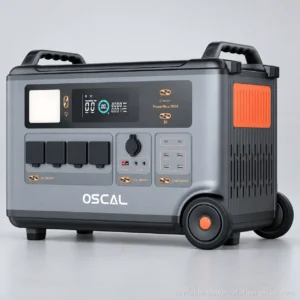
OSCAL PowerMax 6000
Overall rating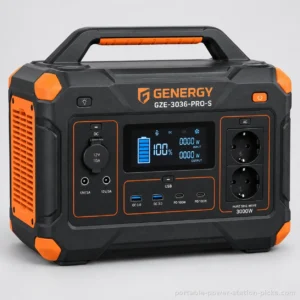
GENERGY GZE-3036-PRO-S
Overall rating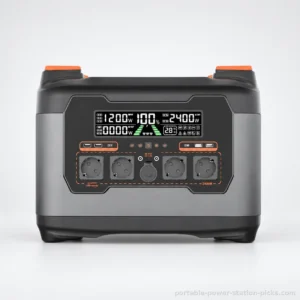
Kodak S2400M
Overall rating
Jackery Explorer 2000 v2
Overall rating
EcoFlow DELTA 2
Overall rating
EcoFlow DELTA 3
Overall rating
Have a question about this model?