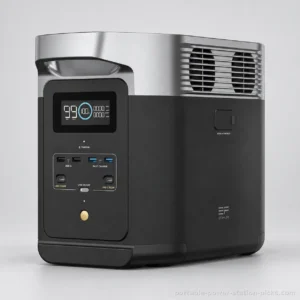
EcoFlow DELTA 2
Top-ranked for weight and equipment.
Read the review Our rankingsThe best portable power stations8 portable power stations
By solar
By rated power
By battery capacity
By maximum solar input power
Our guides to choosing
The usable capacity between 2 charges sets apart different models of portable power station, provided they have enough power to run your devices simultaneously and their weight is manageable when travelling.
Prices collected from retailers are for guidance only: they may have changed since, the current price is the one shown by the retailer. No price is shown for models sold only on Amazon. Amounts converted from reference prices in euros using a dated exchange rate.
Top-ranked for weight and equipment.
Read the review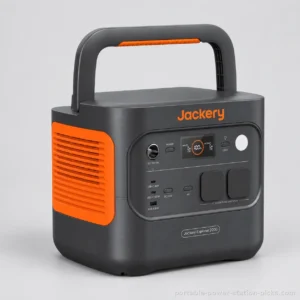
Key strength: equipment, rated 9/10.
Read the review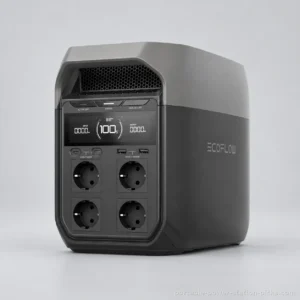
Key strength: number of 230 v sockets, rated 9.3/10.
Read the review| Rankings | Rating | Price | Rated power | Battery capacity | Weight | Mains charging time | Maximum solar input power | Total power of included solar panels | Number of 230 V sockets |
|---|---|---|---|---|---|---|---|---|---|
| 1. EcoFlow DELTA 2 | 8.5/10 | $593 | 1800 W | 1024 Wh | 12 kg | n/a | 500 W | n/a | 4 sockets |
| 2. Jackery Explorer 2000 v2 | 8.5/10 | n/a | 2200 W | 2042 Wh | n/a | 1.7 h | 400 W | n/a | 2 sockets |
| 3. EcoFlow DELTA 3 | 8.4/10 | n/a | 1800 W | 1024 Wh | 12.5 kg | n/a | 500 W | n/a | 4 sockets |
| 4. ALLPOWERS R2500 V2 | 8.3/10 | $885 | 2500 W | 1920 Wh | 24.5 kg | n/a | 1000 W | n/a | 4 sockets |
| 5. BLUETTI Elite 200 V2 | 8.3/10 | n/a | 2600 W | 2073.6 Wh | 24.2 kg | n/a | 1000 W | n/a | 2 sockets |
Rankings are based on our review ratings, calculated by comparing manufacturer specifications across the full catalogue.Our methodology.
The best portable power station depends on your devices and their power consumption. Based on an analysis of the specifications, the EcoFlow RIVER 3 Plus suits modest needs, the DELTA 2 offers more power, and the BLUETTI Elite 300 prioritises energy storage capacity. Their suitability also depends on how much time you have to recharge them.
A portable power station can recharge your portable devices, power camping equipment or keep certain essential appliances running during an outage. It is suitable when you need electricity away from a socket and have an opportunity to recharge between uses.
Electrical compatibility and runtime are separate considerations. Being able to start an appliance does not mean being able to power it for long. For a refrigerator, you need to know its power consumption and startup surge before choosing. When powering several devices, their simultaneous power requirements add up.
Powering appliances directly does not automatically replace a home backup power system. Connecting to your home's electrical system requires a suitable solution.
This comparison uses the recorded prices and available specifications. “Not specified” indicates missing or insufficiently clear information.
| Model | Price | Capacity | Continuous / peak power | Weight | Stated recharge time |
|---|---|---|---|---|---|
| EcoFlow RIVER 2 | Check the retailer for the price | Not specified | Not specified | Not specified | Fully charged in 60 min |
| EcoFlow RIVER 3 Plus | Check the retailer for the price | 286 Wh | 600 / 1 200 W | 4,7 kg | AC charging in 1 h |
| BLUETTI AC70 | Check price at retailer | 768 Wh | 1 000 / 2 000 W | Not specified | Not specified |
| EcoFlow DELTA 2 | Check price at retailer | 1 024 Wh | 1 800 W / not specified | 12 kg | 500 W solar input |
| BLUETTI AC180 | Check price at retailer | Not specified | Not specified | Not specified | 0 to 80% in 45 min |
| EcoFlow DELTA 3 Plus | Check price at retailer | 1 024 Wh | 1 800 / 3 600 W | 12,5 kg | AC charging in 56 min |
| BLUETTI Elite 200 V2 | Check price at retailer | 2 073,6 Wh | 2 600 / 5 200 W | 24,2 kg | Up to 80% in 45 min with dual charging |
| BLUETTI Elite 300 | Check the retailer for pricing | 3 014,4 Wh | 2 400 / 4 800 W | 26,3 kg | Not specified |
| EcoFlow DELTA Pro | Check the retailer for pricing | Included capacity not specified | Not specified | Not specified | Not specified |
| EcoFlow DELTA Pro Ultra | Check the retailer for pricing | 6 144 Wh | 6 900 W / not specified | 82,8 kg | 80% in 73 min |
The AC70 is a mid-range option for moderate needs. The DELTA 3 Plus appeals to those who prioritise fast mains charging. The Elite 200 V2 prioritises power but remains heavy. The DELTA Pro Ultra is primarily intended for home use with little need to move it.
When looking for an affordable portable power station, the models listed fall within the lower price range. The higher price ranges cater to increasingly demanding needs. These price ranges do not imply that any accessories are included.
Our selection is based on the retailer listings provided, without hands-on use or usable aggregated feedback. We prioritise explicit specifications. The generic power fields for the RIVER 3 Plus and DELTA 2 are contradictory; the table uses their detailed descriptions. For the DELTA 3 Plus, we use 1 024 Wh, as the unit in the sales copy is inconsistent.
The information on the RIVER 2, AC180 and DELTA Pro remains insufficient for a firm recommendation.
Continue with the selection on this page based on your power consumption and transport constraints. For a specific need, the selection “Best portable power station compatible with solar charging » provides a closer look at this criterion.
The best portable power station is the one that covers your energy needs between 2 charges, delivers the power you need and is manageable for you to carry. Before comparing models, list your devices, how long you use them and your charging options. This information helps you avoid a battery that falls short or is unnecessarily bulky.
| Model | Recorded price | Weight | Power in watts | Power output | Recommended uses for the product |
|---|---|---|---|---|---|
| EcoFlow RIVER 2 | Check price at the retailer | N/A | N/A | N/A | N/A |
| EcoFlow RIVER 3 Plus | Check price at the retailer | 4,7 | 1200 Watts | 1200 Watts | Camping |
| BLUETTI AC70 | Check price at the retailer | N/A | N/A | N/A | N/A |
| EcoFlow DELTA 2 | Check price at the retailer | 12 Kilograms | 1024 Watt-hours | 3 Kilowatts | Camping, Home use |
| BLUETTI AC180 | Check price at retailer | N/A | N/A | N/A | N/A |
| EcoFlow DELTA 3 Plus | Check price at retailer | 12,5 kilograms | N/A | N/A | Camping |
| BLUETTI Elite 200 V2 | Check price at retailer | 24,2 kilograms | 2073.6 watt-hours | 2600 watts | Camping, Home use, Industrial use |
| BLUETTI Elite 300 | Check price at retailer | 26,3 kilograms | 3014.4 watt-hours | 2400 watts | Camping, Home use |
| EcoFlow DELTA Pro | Check price at retailer | N/A | N/A | N/A | N/A |
| EcoFlow DELTA Pro Ultra | Check price with the retailer | 82,8 Kilograms | 6900 Watts | 6900 Watts | Motorhome, Home, Emergency |
The comparison helps you identify models suited to your needs. However, any missing information should be checked before buying, especially when it concerns available power or included capacity.
The capacity in Wh represents the energy reserve. To size your power station, start with the appliances you need to power between charges, then apply this calculation to each one.
The nominal capacity does not fully reflect the energy available to your appliances. Electrical conversion and the station’s operation also consume energy. Allow a margin rather than choosing a capacity that exactly matches your calculation.
For a refrigerator, use consumption measured over a representative period. Multiplying its running power by the entire length of your stay would be misleading, as its compressor runs intermittently.
The continuous power in W determines which appliances you can use simultaneously. Add up their power requirements, then separately check the startup requirements of equipment with motors. Peak power is no substitute for power that can be sustained.
The RIVER 3 Plus illustrates this pitfall. Its specifications state 600 W of continuous output and 1 200 W of peak power, despite generic fields showing 1 200 W. For the DELTA 2, we use the 1 800 W stated in the description, while flagging the contradictory field listing 3 kW.
Multiple sockets do not multiply the total power available. Also check the conditions for modes that allow you to power certain more demanding appliances. A marketing claim alone does not confirm compatibility with your equipment.
Choose based on the energy sources you can actually access. Mains power is suitable if you regularly have access to a socket. In a vehicle, check input compatibility, the cable required and the supported charging power before relying on your journeys.
With solar charging, the supported input power does not guarantee actual generation. Sunlight and panel installation affect charging. The DELTA 2 lists a solar input of 500 W; the DELTA 3 Plus lists 2 inputs of 500 W. These values describe their input capabilities, not constant generation.
Check the voltage range, connectors and whether panels are included in the offer. Also compare the conditions behind the stated charging times. The Elite 200 V2 reaches 80% in 45 minutes according to its description, but with combined alternating current and direct current charging.
Consider the weight in relation to how you will actually use it. Occasionally moving a power station around the house and carrying it every time you set up at a campsite place different demands on you.
The RIVER 3 Plus has a stated weight of 4,7 kg, compared with 12 kg for the DELTA 2 and 26,3 kg for the Elite 300. With a stated weight of 82,8 kg, the DELTA Pro Ultra requires suitable handling arrangements and a suitable location.
Next, check which outputs you need, rather than just how many there are. For a laptop that charges via USB-C, check the port's power output and cable compatibility. For equipment powered by direct current, check its voltage, connector and the power available from that output.
The stated cycle counts describe endurance under specific conditions. The RIVER 3 Plus specifies 3 000 cycles with 80% capacity remaining. This means neither that it will fail after that threshold nor that the warranty covers that period.
The selection “Best portable power station with a LiFePO4 battery” explores this criterion in more detail. However, battery chemistry should not overshadow the capacity you need, warranty terms and repair options.
For expandable capacity, check which batteries are compatible, how much space they take up and how much they cost. The stated maximum capacity is not necessarily included.
An uninterruptible power supply function does not guarantee compatibility with all sensitive devices. Check their requirements and the switchover time. Powering devices directly differs from connecting to your home's electrical system, which requires suitable equipment and professional installation.
The prices recorded in our selection fall into 3 bands, without constituting an exhaustive market study.
A search for “cheap portable power station” should factor in the cost of the complete setup you need: panels, cables and additional batteries can affect your budget.
Determine your capacity and power requirements before comparing prices. Focus on usable capacity, continuous power and charging options that suit your travel needs. The right choice meets your needs while keeping weight and cost within acceptable limits.
The best power station depends on the devices you need to power and the expected time between charges. Based on our analysis of the supplied specifications, the EcoFlow RIVER 3 Plus suits modest needs with 286 Wh and 600 W of continuous power. The DELTA 2 offers more power, with 1 800 W stated in its description. The BLUETTI Elite 300 prioritises energy capacity with 3 014,4 Wh, but weighs 26,3 kg.
Start by calculating your energy needs, then check the power requirements of devices used simultaneously. The capacity in Wh determines the energy reserve you need; continuous power in W determines which devices can run together. Then compare weight, outlets and charging options. If you are looking for a “cheap portable power station”, also check the included accessories: panels, cables and additional batteries can affect the total cost.
The available data can help you choose an EcoFlow model, but does not allow a fair comparison between EcoFlow and Jackery. No Jackery specification sheet is included in this guide. In the EcoFlow range, the RIVER 3 Plus combines 286 Wh with a weight of 4,7 kg, while the DELTA 2 lists 1 024 Wh at 12 kg. Compare these specifications with those of a specific Jackery model before deciding.
This guide does not provide enough evidence to name any brand as the best for every use. The EcoFlow and BLUETTI stations featured here offer different capacities, power outputs and weights. Compare models that meet your needs, then check the warranty, after-sales service terms and compatible accessories. Our analysis is based on the supplied specification sheets, without hands-on assessment or usable aggregated feedback to compare brand reliability.
Runtime depends on the refrigerator’s actual energy consumption and the energy the station can actually supply. Since the compressor runs intermittently, its rated power alone is not enough to calculate a reliable runtime. Use consumption measured over a representative period to calculate runtime from the available energy, allowing for conversion losses. Also check that the station can handle the compressor’s startup surge before comparing capacities.
W indicates the power the station can supply, while Wh indicates its energy reserve. The basic calculation is energy in Wh = power in W × time in hours. The RIVER 3 Plus lists 286 Wh, 600 W of continuous power and 1 200 W of peak power. This peak power does not replace continuous power and cannot be used to determine runtime.
No, the panel must meet the station’s solar input specifications. Check the permitted voltage, accepted current, connectors and required cables. The DELTA 3 Plus, for example, lists 2 inputs of 500 W each, with a range of 11 to 60 V. The supported solar input power does not guarantee actual output: sunlight and panel orientation affect charging. Also check whether panels are included.
Yes, a station can power compatible essential appliances, but not necessarily the whole home or for the entire outage. Check the combined power requirements and energy consumption over the intended period. Powering devices directly and connecting to a home’s electrical system are different uses; connecting to the electrical system requires suitable equipment and a qualified professional. The guide “Best portable power station for home backup” explores this specific choice in more detail.