Best portable power station Jackery 2026, analysis and reviews
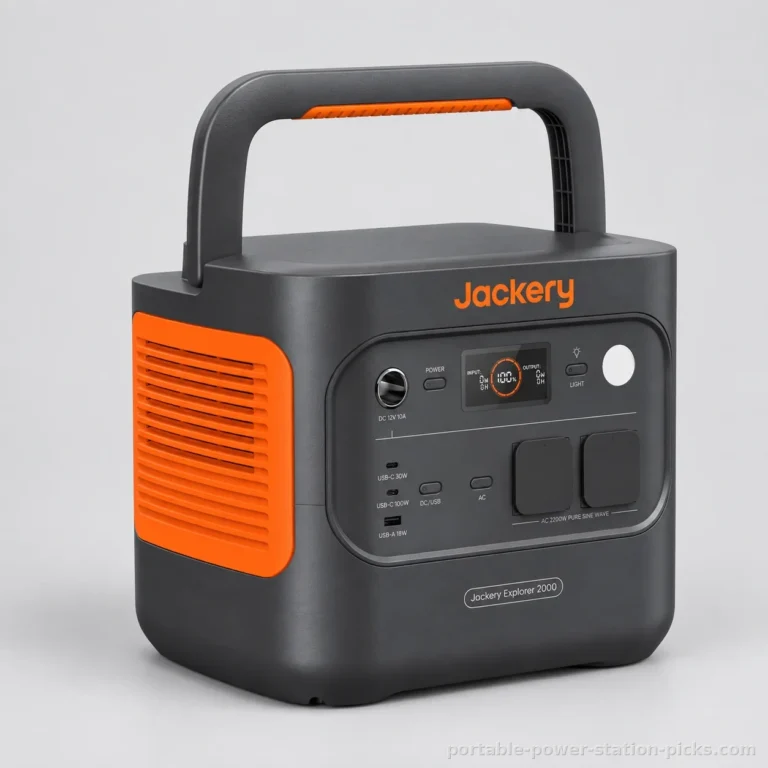
A freezer full of groceries gives an outage a very practical deadline. Jackery’s Explorer 2000 v2 is the model we recommend here for home backup and demanding appliances, with a large battery reserve and strong rated output. The catch is simple: an appliance can fit within its power limit and still drain that reserve quickly. Choose it around the equipment you need, rather than treating every outlet as an invitation.
Prices collected from retailers are for guidance only: they may have changed since, the current price is the one shown by the retailer. No price is shown for models sold only on Amazon. Amounts converted from reference prices in euros using a dated exchange rate.
Why these models are listed here
- 1 model selected because they have the feature “Jackery” according to data published by manufacturers and retailers.
- See how we rate →
- No brand pays to be included in this selection or to rank higher.
Can a Jackery portable power station keep your outage priorities running?
When a thunderstorm cuts the electricity, your household probably does not need every appliance running at once. Perhaps the freezer comes first, followed by a lamp and the devices you use to stay in touch. The Jackery Explorer 2000 v2 makes sense for that focused backup duty. It is the only model in this selection, and its strengths point toward keeping selected equipment available at home. That is a more convincing reason to choose it than having a few phones to charge.
Start your buying decision with the appliances, not the battery. Check the combined electrical demand of everything you expect to run together, then decide which loads deserve the stored energy. Equipment that keeps food cold may earn priority over an appliance that makes a hot snack. This simple order keeps a strong output specification from becoming an excuse to connect the whole kitchen.
The Explorer 2000 v2 supplies rated power of 2200 W, placing it among the best on the site for this criterion in our analysis. That is enough output for a demanding appliance whose requirements stay below the limit. Remember that connected devices share the available output. If you add another appliance, its demand joins the total; the station does not assign a fresh power allowance to each socket.
Next comes the battery capacity of 2042 Wh, a very large energy reserve designed for home backup or RV use. Its capacity also ranks among the best on the site in our analysis. Watt-hours describe stored energy; watts describe the power available at a given moment. For your buying decision, that means checking that the station can support your chosen equipment, then deciding how carefully you want to spend the reserve.
Its main weakness is limited reserve for appliances with high power consumption. That matters even when an appliance fits comfortably within the output limit. A power-hungry device can be compatible and still make a poor companion for an extended outage. We would prioritize necessary loads and use demanding appliances for deliberate tasks, instead of leaving them connected simply because the station can supply them.
What would you keep running if the neighborhood stayed dark through the evening? Make a short list and distinguish equipment that needs ongoing power from devices you use briefly. A lamp where the family gathers has a different job from a kitchen appliance used for a single task. We like the combination of substantial capacity and strong output because it gives that plan useful flexibility. The battery still needs someone to decide what matters.
The mains charging time is 1,7 h. Charging from an outlet belongs in your preparation routine while household electricity is available, alongside locating flashlights and organizing the cords your equipment needs. Follow the manual: the station is vulnerable to rain and high heat. Keep it sheltered and charge it in a ventilated area.
This is backup for selected equipment, not a replacement for utility power or a fuel-powered generator serving your entire home. Connecting it to home electrical wiring requires an electrician and manufacturer-specified equipment. Never use an improvised outlet connection. For a household that wants a substantial reserve for prioritized appliances during an outage, choose Jackery Explorer 2000 v2. Give it a clear job before the lights go out.
Can the Jackery Explorer 2000 v2 power appliances at an RV campsite?
An RV kitchen can make a campsite without electrical hookups surprisingly demanding. A countertop appliance gets switched on, another device needs power, and the battery suddenly has several jobs. The Explorer 2000 v2 belongs on your shortlist when a demanding appliance is part of the trip. Its rated output and capacity both rank strongly in our analysis. The useful question is which appliances you intend to run together and which can wait their turn.
Begin with the rated output of 2200 W. Compare that limit with the combined demand of your intended equipment. If a kitchen task needs most of the available output, schedule other demanding tasks separately. That is a practical buying rule you can apply before packing: choose around the busiest combination you actually need, rather than adding every appliance you own to a theoretical wish list.
Motor-driven equipment brings a separate requirement. Surge power is not rated continuous power: a motor-driven appliance requires a surge when it starts. Refrigeration is a relevant example for an RV or home backup plan. Match both operating and startup requirements to the station’s specifications. A strong continuous output rating is useful, but it does not establish that every motor-driven appliance will start successfully.
Then decide how much of the reserve each task deserves. The capacity of 2042 Wh gives this Jackery a clear role in RV use, especially when your routine includes more than personal electronics. Its weakness remains sustained high consumption. An occasional kitchen task makes a different demand from an appliance you want running throughout your stay. Your breakfast equipment does not become less hungry because it has a lake view.
Would you rather spend stored energy on that task now or preserve it for equipment you need after dark? There is no universal answer, but there is a useful distinction: an appliance that fits the output limit can still consume more energy than you want to give it. We would choose the Explorer 2000 v2 for planned appliance use, with clear priorities for the rest of the reserve. Unrestricted use is where its appeal fades.
Electrical connections deserve attention before you buy. The verified higher-voltage AC outlet configuration provides 2 sockets. Check your appliances’ plugs and voltage requirements against that configuration; do not assume compatibility with standard US household equipment. Its socket provision ranks well in our analysis, but a convenient socket count only helps when the electrical supply suits the devices you intend to connect.
The non-USB DC output is 12 V cigarette lighter socket, which gives compatible vehicle-style equipment another connection option. Compare the device’s connector and electrical requirements with that output when building your packing list. Wi-Fi connectivity is also included in the equipment package. Overall, the Explorer 2000 v2 places among the best on the site for equipment in our analysis. Those connections matter most when they serve something you already plan to bring.
A built-in carrying handle provides a designated grip for moving the station between storage and its working location. Plan those moves around your setup: loading the RV, placing the station near compatible equipment, and keeping charging ventilation clear. The handle is a useful transport feature, but it does not turn a home-backup reserve into something every camper needs to carry around. For an RV stay with a defined demanding-appliance job and other energy priorities afterward, choose Explorer 2000 v2 for RV use.
Is this Jackery portable power station right for camping mainly on solar?
Solar compatibility can make a campsite without hookups sound wonderfully self-contained. The Explorer 2000 v2 calls for a more specific recommendation. It accepts solar charging, with maximum solar input of 400 W. That is a substantial input and a useful charging option. Our selection analysis nevertheless points toward home backup and demanding appliances, rather than choosing this model primarily for substantial solar charging.
The distinction matters when you picture your daily routine. Taking stored energy to camp and adding solar when conditions cooperate is different from expecting solar replenishment to support demanding consumption throughout the trip. We like solar charging as an additional way to replenish this Jackery. What holds us back is making it the foundation of a stay where your appliance routine depends on replacing substantial amounts of energy every day.
Maximum solar input is not what a panel will deliver: output depends on sunlight, orientation, and the panel. A clearing with open sky gives a panel a different opportunity from a parking spot beneath trees. Clouds change the situation again. The input specification describes what the station can accept; it is not a promise that the same amount will arrive whenever panels are connected. Sunshine does not take reservations.
Think through the jobs you want electricity for. You might head out on a hike, return to prepare food, and want useful power again after sunset. Those plans draw on stored energy. They do not establish how much charging will happen while you are away. For this Jackery, we would begin with the reserve you bring and the appliances you prioritize, then treat available sunlight as a contribution to that plan.
A trip centered on sustained heavy consumption and substantial solar replenishment is not the case we recommend this selection for. Avoid it if that is your main requirement. Its stronger role is carrying a large reserve into a defined situation, such as selected household backup loads or occasional demanding-appliance use in an RV. Solar compatibility broadens your charging options without changing the limits of the stored energy.
Package contents also affect how you prepare. “Solar compatible” does not mean “includes a panel”. Choose a package whose stated contents match the panels and cables you intend to use, with connections specified for the station. This matters especially at a campsite without an outlet: the charging capability is useful only when you bring compatible equipment. A charging plan should survive opening the trunk.
The battery chemistry is LiFePO4. That is a concrete specification to include in your decision, but chemistry alone does not establish appliance runtime. Usable energy is lower than advertised capacity, and consumption depends on the appliance. If your main concern is keeping essential equipment supplied, prioritize capacity, compatible output, and the demands of that equipment. Chemistry should support your comparison, not replace those questions.
This selection also makes less sense for a family tent where the main job is charging phones. The Explorer 2000 v2’s large reserve and demanding-appliance output are its reasons to choose; a light charging routine gives those strengths less work to do. At the other extreme, sustained power-hungry equipment runs into its limited reserve for that use. The sweet spot is substantial but selective demand, with a clear reason for each connected appliance.
Among Jackery’s best-rated models in our analysis, the Explorer 2000 v2 earns its place through that focused role. Charge from an outlet before departure when one is available, allocate the reserve to the jobs you care about, and use compatible solar equipment as an additional charging route. For occasional campsite appliance duty with stored energy carrying the main responsibility, choose Jackery for planned campsite power.
Does the Explorer 2000 v2’s battery chemistry tell me how long appliances will run?
Its chemistry is LiFePO4, but chemistry alone does not establish runtime. Usable energy is lower than advertised capacity, and appliance consumption determines how quickly it is spent. Choose around the equipment you need, its electrical requirements, and which loads deserve priority.
Does solar compatibility mean panels and cables come with the station?
“Solar compatible” does not mean “includes a panel”. Choose the package around its stated panel and cable contents, using connections specified for the station. Solar compatibility describes a supported charging option; package contents determine which accessories you will have available when you unpack.
Can the Explorer 2000 v2 power a demanding appliance?
Its rated output is 2200 W, enough for a demanding appliance whose requirements stay below that limit. Include other connected devices in the total. Surge power is not rated continuous power: a motor-driven appliance requires a surge when it starts. High consumption also drains the reserve quickly.
Should I choose this Jackery mainly for solar charging?
We recommend it primarily for home backup or planned appliance use. Its maximum solar input is 400 W, but substantial solar charging is not its recommended role here. Maximum solar input is not what a panel will deliver: output depends on sunlight, orientation, and the panel.
Will the AC outlets suit my US appliances?
Check each appliance’s plug and voltage requirements against the verified higher-voltage AC configuration before buying. The specified socket provision is 2 sockets. Socket count and rated power do not establish electrical compatibility; the connection and supply must suit your equipment too.